
There has been a slight change to the back-on-the-line procedure from 1st January 2023 and it is probably more in line with what golfers actually did, rather than what they were meant to do, following the 2019 rule changes.
This procedure for getting a ball in play is relevant for a few situations:
- Penalty Area Relief (Rule 17)
- Unplayable Ball Relief (Rule 19)
- Taking relief outside a bunker from an Abnormal Course Condition in the bunker (Rule 16)
From 1st January 2023, You must now drop on the line (or as close to it as you can estimate) and the ball can then roll up to a club length in any direction from where it first landed. As long as it does not end up closer to the hole than your original reference point (e.g. where it last crossed into the penalty area from which you are taking relief) your ball will be in play.
The diagram below also helps explain what is OK or not OK.
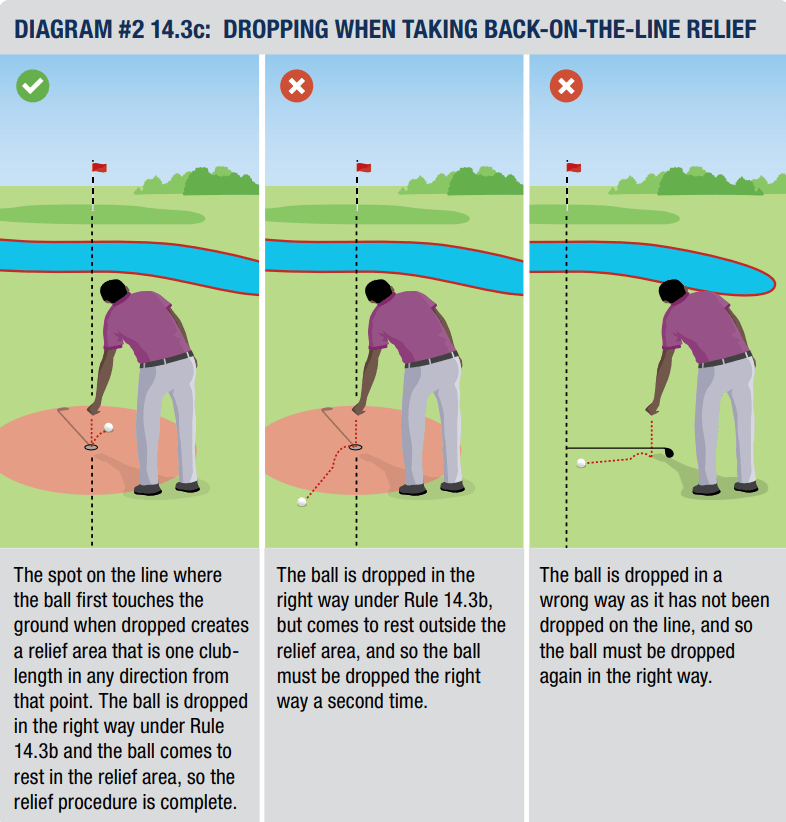


It appears that the ball in the first diagram is closer to the hole. I thought that was not allowed.
LikeLike
Hi Shari
It is not allowed in 2021 (unless model local rule E-12 is in place), but will be allowed from 1st January 2023.
LikeLike
Thank you!
Shari Hardinger
<
div dir=”ltr”>
<
blockquote type=”cite”>
LikeLike
Do you have to hit from inside the relief area or can you be outside it ?
LikeLike
You must play from inside the Relief Area. If you play from outside it you will have played from the wrong place and would incur the general penalty (2 strokes or loss of hole).
LikeLike
Assume it’s ok to stand outside as long as ball is inside when hit😉
LikeLike
Yes – it is the ball that must be within the relief area. You may take your stance outside it.
LikeLike
Thank you Stuart – I mean Ken in the course!
LikeLike
Jon Rahm did not comply with the back on the line relief on the 18th hole in yesterdays FedEx St Jude. He marked the line and then dropped 2 club lengths to the right of the line. Most odd, was in the presence of a rules official.
LikeLike
I can not see a Rule that contemplates the question:
When a ball is dropped under 17.1d(3) and after dropping inside relief area touches the border of 2 different areas of course such as on green and on fringe simultaneously and stays at rest on the fringe what procedure should we use?
LikeLike
One of the restrictions to the relief area under 17.1d(3) (and generally) is that “if there is more than one area of the course is located within two club-lengths of the reference point, the ball must come to rest in the relief area in the same “area of the course” that the ball first touched when dropped in the relief area”.
A ball is always treated as lying in only one area of the course. Individual rules let you know when a ball is in a specific area. (Penalty Area (Rule 17.1a), Bunker (Rule 12.1), Putting Green (Rule 13.1a), Teeing Area (Rule 6.2b(1)).
If more than one of these definitions applies then and we need to look at Rule 2.2c for clarification to the area it is treated as being in, and we have the following order of precedence (it will be treated as in the first named of any applicable area:
1. Penalty Area
2. Bunker
3. Green
4. Teeing Area
5. General Area
We would use the same order of precedence to identify which area of the course the ball was dropped into.
If I understand your scenario correctly, the ball was dropped and it simultaneously touched the Green and the fringe (General Area), and then came to rest on the fringe (General Area). It would therefore need to be re-dropped under Rule 14.3c(2) as it was dropped onto the Green and has come to rest in a different area. If this were to happen again on the second drop you would then need to place the ball on the spot where the ball dropped the second time first touched the ground (again Rule 14.3c(2).
I hope this clarifies.
LikeLike
The dropping back on the line relief option is also available if you ball is lost in an abnormal course condition. As long as it is known/virtually certain that the ball is lost in ACC.
LikeLike
Hi Gulshan
That is not correct. From an abnormal course condition you must always drop within 1 club length of your nearest point of complete relief. If your ball is lost within the abnormal course condition then you use the estimated point where it last crossed in to that condition as your reference point to find that nearest point of relief. See Rule 16.1e
LikeLike
Yes you are right. It is the nearest point of complete relief, from the point of entry at the edge of ACC. This means you only have this option or stroke & distance, if ball lost in ACC. Back on the line is eliminated / unavailable. Thanks.
LikeLike